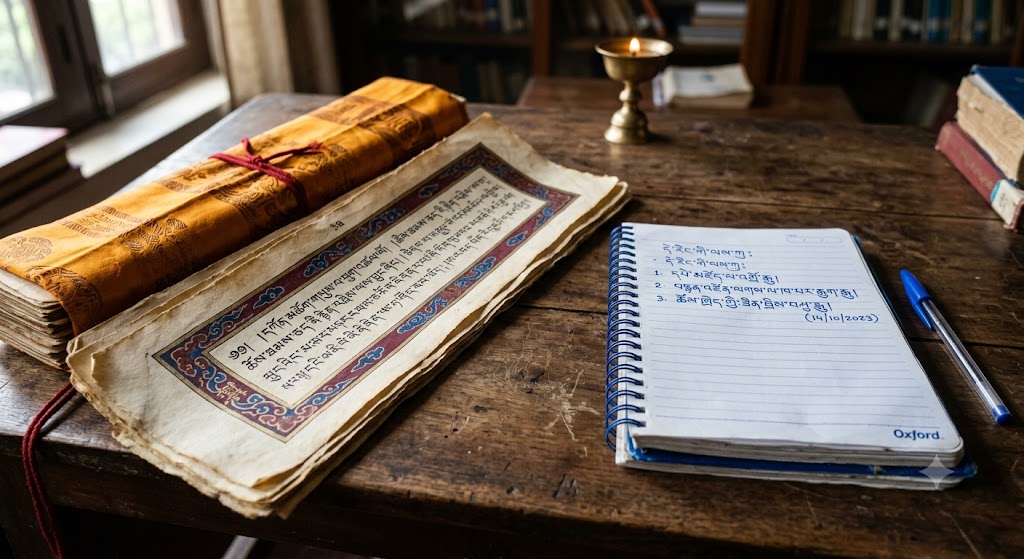
Learning to read Tibetan begins with a single, achievable goal: mastering the alphabet. Once the script clicks, everything else — vocabulary, grammar, pronunciation — has somewhere to anchor. This roadmap walks you through the journey from complete beginner to reading your first syllables aloud.
Why the alphabet comes first
It's tempting to jump straight into useful phrases, but the Tibetan script rewards patience. Unlike a romanized transliteration, the actual script encodes pronunciation rules that transliteration hides. Learn it properly once, and you'll read accurately for the rest of your studies. Skip it, and you'll fight ambiguity forever.
The good news: the alphabet is finite and learnable. Thirty consonants, four vowel marks, and a set of stacking rules. Thousands of learners before you have crossed this exact bridge.
The thirty consonants
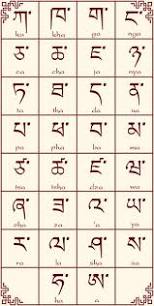
Tibetan has thirty base consonants, traditionally arranged in a grid of eight rows. They're grouped by where and how they're pronounced in the mouth, which makes them easier to memorize than a random list.
Start by learning them in their traditional order — ཀ (ka), ཁ (kha), ག (ga), ང (nga), and so on. The traditional sequence isn't arbitrary; it groups related sounds together, and every textbook and dictionary assumes you know it.
Spend real time here. Write each letter by hand. Say it aloud. The muscle memory of writing cements recognition far faster than passive reading.
Adding the vowels
By default, every Tibetan consonant carries an inherent "a" sound. The four vowel marks — for i, u, e, and o — change that vowel. Three sit above the consonant, one below.
This is where reading starts to feel real: the same consonant ཀ becomes ཀི (ki), ཀུ (ku), ཀེ (ke), or ཀོ (ko) depending on the mark. Once you internalize the four marks, you can read a huge range of simple syllables immediately.
Stacking: where it gets interesting
Tibetan syllables often stack letters vertically, with superscripts, subscripts, prefixes, and suffixes combining around a root letter. This looks intimidating at first, but it follows consistent rules. A superscribed letter sits on top; a subscribed letter tucks underneath.
Don't rush this stage. Work through stacked combinations slowly and systematically, and they'll gradually become as readable as single letters.
Building a daily practice
Consistency beats intensity. Fifteen focused minutes a day will carry you further than a three-hour session once a week. A simple daily routine:
- Review the consonants in order, writing each by hand
- Practice reading five to ten syllables aloud
- Add one new vowel or stacking rule at a time
- Re-read yesterday's syllables before adding new ones
If you'd like structured materials to practice with, our free Tibetan learning resources include alphabet charts and reading exercises to work through at your own pace.
When to bring in a teacher
Self-study takes you a long way with the alphabet, but pronunciation is the one area where feedback matters enormously. It's easy to memorize a letter and pronounce it slightly wrong for months without realizing.
Once you can read basic syllables, consider working with a teacher who can correct your pronunciation early. Our personalized Tibetan classes pair you one-on-one with a native speaker who can catch small errors before they become habits, and tailor the pace to your goals.
Your first milestone
Set a concrete, reachable target: within your first month, aim to read any simple two-syllable word aloud without help. That single milestone proves the script has clicked — and from there, every text, prayer, and conversation becomes something you can begin to approach.
For a fuller set of study materials and vocabulary lists to grow into next, explore our complete Tibetan learning resources and pick the path that matches where you want to go.