
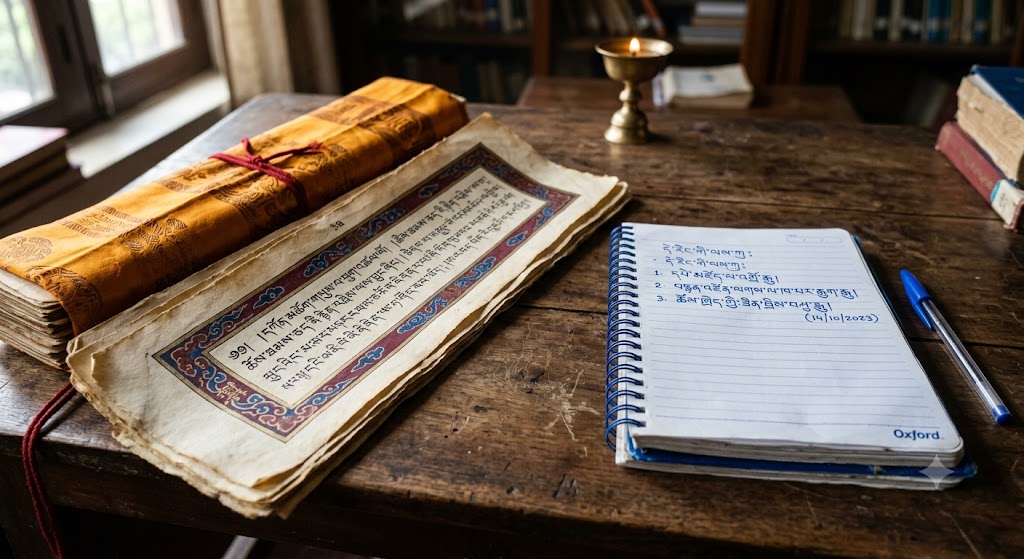
Classical vs. Colloquial Tibetan: Which to Learn First
One of the first questions new learners ask is deceptively simple: should I learn classical or colloquial Tibetan? The answer shapes everything that follows—your textbooks, your teachers, and how you spend your practice hours. Here's how to choose the path that fits your goals.
The one thing they share
Before the differences, the good news: both classical (literary) and colloquial (spoken) Tibetan use the same alphabet. The thirty consonants and four vowels, the stacking of letters, the rules for reading a syllable—these are identical. Whichever direction you eventually take, learning the script first is never wasted effort. It's the shared foundation both branches are built on.
Classical Tibetan: the language of the texts
Classical Tibetan (chö-kä, the "dharma language") is what you'll find in prayers, sadhanas, philosophical treatises, and the vast canon of Buddhist literature. If your motivation is to read The Words of My Perfect Teacher in the original, to follow along in the shrine room, or to eventually translate texts, this is your path.
Classical learners tend to focus on grammar and vocabulary rather than pronunciation and conversation. You may spend months reading fluently before you speak a single sentence aloud—and for many practitioners, that trade-off is exactly right.
Colloquial Tibetan: the language of people
Colloquial Tibetan (phal-kä) is the living, spoken language—what you'd use to greet a monk, order tea in Boudha, or talk with Tibetan friends and family. Pronunciation and listening matter enormously here, and the grammar of everyday speech differs from the literary forms in real ways.
If you plan to live in a Tibetan community, travel in the Himalayas, or build genuine relationships across the language barrier, colloquial Tibetan is what will actually serve you day to day.
So which comes first?
A simple way to decide:
- Choose classical if your goal is reading Dharma texts, prayers, and philosophy.
- Choose colloquial if your goal is conversation, travel, and connecting with people.
- Do both, in sequence, if you have the time—many serious students start with the alphabet and basic grammar, then branch toward their primary goal.
There's no wrong answer, only the answer that matches why you started. A practitioner who wants to understand their daily practice and a traveler preparing for a year in Kathmandu simply need different tools.
Where to start today
Whichever direction calls to you, begin with the script and a clear plan. You can explore our free Tibetan learning resources to test the waters, or work one-on-one with a teacher through our personalized Tibetan classes to build a foundation suited to your goals from day one.
The most important step isn't choosing perfectly—it's choosing something and beginning.